Recall before you reread
Trying to remember sticks better than reading again. Practice starts with a question, and a mistake becomes a clue, not a telling-off.
School, English and German, with an AI tutor
Questions, games and flashcards on your topic, review on the right day and a tutor who explains in another way when you get stuck. For students in Brazilian schools and for Portuguese speakers learning English or German.
Notebooks you can open:
Free during the beta. No card needed.
The lessons and the tutor explain in Brazilian Portuguese. The app's menus are also in English.
20-second test
Three questions so you can feel how it works. No sign-up, and nothing leaves your browser. If you get one wrong, you get a clue and try again.

Explicadora in testing
The Explicadora is a simple character who explains the topic out loud, sentence by sentence, with captions. She asks a short question, takes your answer, typed or dictated, and, if you get stuck, explains in another way. In her very first sentence she says she is an artificial intelligence.
Why it works
Every part of the app follows a tested idea: recalling before rereading, reviewing on the right day and explaining in your own words.
Trying to remember sticks better than reading again. Practice starts with a question, and a mistake becomes a clue, not a telling-off.
What you got right comes back in a few days, and what gave you trouble comes back sooner. That is spaced review, in short sessions.
Many questions ask for the answer in your own words before showing any option. The clue comes only afterwards.
The tutor answers from the lesson you are studying and shows where the answer came from. If the first explanation does not click, it tries another one.
The map shows what is new, being learned, solid or mastered. No comparing yourself to others and no grade judging you.
Sources:Roediger and Karpicke (2006), Psychological Science, on recalling before rereadingCepeda and colleagues (2006), Psychological Bulletin, on spaced reviewDunlosky and colleagues (2013), Psychological Science in the Public Interest, on the study techniques that work best
In three steps
You create the account in a minute. Then a short conversation builds the plan, and the daily practice fits your routine.
You create the account in a minute. Then you tell the tutor your goal, the time you have and what you already know. There are only a few questions, most of them taps.
The plan breaks the path into short sessions, with reviews scheduled and a clear next step. If you are doing well, practice gets harder; if you get stuck, the plan takes a smaller step. It changes when your routine changes.
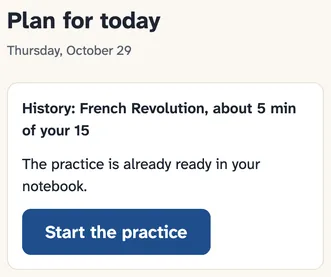
Each day has a short session to recall, practise and listen. When you need it, you ask for an explanation and the tutor shows where the answer came from.
Languages and school
Two paths, one idea: short practice, a plan that adapts, and an explanation when you need it.
German and English from A1 to B1, for Portuguese speakers: the lessons explain in Brazilian Portuguese. Reading, listening, dictation, vocabulary, grammar and writing. The content is in beta: if you find a mistake, tell us and we fix it.
Each subject is a notebook. You type the topic, the practice is built on the spot and saved in the notebook. When exams come, a mock test covers the whole notebook.
For parents and guardians
When it opens, only an adult will be able to create a child's account. You decide what the child sees and does, and the dashboard shows how long they studied, what they studied and where they got stuck. No marketing aimed at the child.
Plans
Everything that is ready today is free and asks for no card. When the paid plans open, you get a notice first, see the price and choose. Nothing is charged on its own.
No fine print
What we can answer today, with the product as it is now.
Yes. During the beta, using the product is free and we do not ask for a card. The beta is the period when we test and adjust before opening the paid plans.
No. Creating an account and using the beta does not ask for a card. When billing starts, you will be told in advance and can decide.
There is no billing during the beta, so there is nothing to cancel. When the paid plans open, cancelling will be as simple as subscribing, and the seven-day right of withdrawal under the Brazilian Consumer Defense Code applies.
You can write or dictate with the microphone, and the Explicadora explains out loud, with captions. Talking to the tutor by voice, like a phone call, is still in testing, for adults only.
Yes. It works in your phone's browser, with nothing to install. If you like, you can add EstudaVai to your home screen.
You choose the time you have. The plan builds short sessions to fit it, and can add more later if you want.
Not yet. During the beta, only adults create an account. A child's account will be created by a guardian, with a dashboard and controls, after the legal review.
No. The tutor helps you understand the subject and practise, but it does not replace the teacher, give grades or decide who passes.
Not yet by a native speaker. The German and English content is in beta: when someone finds a mistake, we fix it.
Your next step
Create your account, tell it what you want to learn and see your first plan. The beta is free and needs no card.